The Power of Story
Why Stories Move People to Act
25 min read
Learning Objectives
- Explain how storytelling activates brain-to-brain neural coupling and why this biological synchronization matters more than any marketing tactic
- Critically evaluate the role of oxytocin in prosocial behavior — including what the science actually supports and where popular claims are oversimplified
- Apply the Identifiable Victim Effect to craft appeals that center one person's story, while understanding the ethical boundaries of this cognitive bias
- Distinguish between story-first and data-first communication using real fundraising metrics that prove the difference
- Identify at least 5 contexts where nonprofit organizations need stories, and recognize the boundary conditions where storytelling alone is insufficient
Introduction: The $592.50 Billion Paradox
Americans gave an estimated $592.50 billion to charitable causes in 2023, according to Giving USA. That number represents the largest single-year outpouring of voluntary generosity in human history.
And yet the donor base is shrinking.
The percentage of American households that give to charity has declined from 66% in 2000 to roughly 49% today. Fewer people are giving, even as those who do give are giving more. The sector is increasingly dependent on a narrowing pool of major donors while losing the broad base of small and mid-level supporters that sustains organizational health.
The conventional explanation is donor fatigue, generational shifts, or economic pressure. Those factors are real, but they obscure a more fundamental problem: most nonprofit communication is built on a flawed assumption about how human beings process information and make decisions.
The assumption is this: if you present enough evidence of need -- enough data, enough statistics, enough proof that a problem exists -- rational people will respond rationally and take action.
They won't. And the research is unambiguous about why.
Human beings are not wired to respond to information. We are wired to respond to stories. This is not a metaphor, not a marketing platitude, and not a preference. It is a neurobiological fact with decades of peer-reviewed research behind it. Stories activate brain regions that data cannot reach. They trigger chemical responses that spreadsheets never will. And they create the kind of emotional engagement that transforms passive awareness into active commitment.
This lesson explores the science behind that claim. By the end, you will understand not just that stories work, but how they work at a neurological level, why they outperform every other form of communication for driving action, and where their power has limits you need to respect.
We begin inside the brain.
The Neurobiology of Narrative Transportation
Hasson's fMRI Study
In 2010, neuroscientist Uri Hasson and his team at Princeton published a landmark study using functional magnetic resonance imaging (fMRI). They recorded a woman telling an unrehearsed, real-life story while scanning her brain activity. Then they played the recording for listeners while scanning their brains.
What they found redefined our understanding of human communication.
During the story, the listeners' brain activity began to mirror the storyteller's brain activity. Not just in language-processing centers, but across motor cortex, sensory cortex, frontal cortex, and the insula -- regions associated with movement, physical sensation, planning, and emotional processing.
Hasson called this phenomenon neural coupling: the listener's brain synchronizes with the storyteller's brain in real time, and in some cases actually anticipates what comes next, firing patterns slightly ahead of the storyteller.
This is narrative transportation -- the neurological state in which a person's attention, emotion, and mental imagery become fully absorbed in a narrative. It is not passive reception. It is active co-creation. The listener's brain is literally simulating the experience being described.
Three Critical Findings
Hasson's research produced three findings that matter for anyone communicating on behalf of a mission:
1. Stories activate the whole brain, not just language centers.
When you read a spreadsheet, your brain activates two regions: Broca's area (language production) and Wernicke's area (language comprehension). These are the brain's language processors, and they do exactly what you'd expect -- they decode symbols into meaning. The experience is cognitive, linear, and detached.
When you hear a story, the entire brain lights up. Motor cortex activates when a character moves. Sensory cortex activates when the narrative describes smells, textures, or sounds. Emotional centers fire when a character faces danger or relief. The listener is not processing the story. The listener is living it.
2. The degree of coupling predicted comprehension and influence.
When coupling was high -- when the listener's brain closely mirrored the speaker's -- the listener reported deeper understanding, stronger agreement, and greater willingness to act on the information. When coupling was low, even factually identical information failed to land.
This means that how you deliver information matters at least as much as what information you deliver. A story told well creates neural coupling. A report delivered competently does not. The audience's brain literally cannot process them the same way.
3. Coupling worked across languages and cultures.
Subsequent research by Hasson's lab demonstrated that neural coupling occurred even when stories were translated into different languages. The coupling was content-driven, not language-driven. The meaning of the narrative, not the specific words, created the synchronization.
Beyond the Scanner
The implications extend beyond laboratory curiosity. Neural coupling explains why:
- A donor who hears a beneficiary's story at a gala remembers it six months later, while the statistics from the same event are forgotten by morning
- A volunteer who watches a two-minute video about one family's experience signs up for a year-long commitment, while a volunteer who reads a program overview does not
- A board member who visits a program site and hears stories directly becomes a more effective advocate than one who only reads quarterly reports
Key Insight: Stories are not a communication style. They are the brain's native format for processing, encoding, and acting on information about other human beings. When you communicate through story, you are working with the brain's architecture. When you communicate through data alone, you are working against it.
The Neurochemistry of Empathy: Oxytocin and Prosocial Behavior
If neural coupling explains the mechanism of story's power, neurochemistry offers a window into the engine. The most influential research in this space comes from neuroeconomist Paul Zak and his lab at Claremont Graduate University, who have spent over a decade studying what happens in the body when people encounter character-driven narratives.
The Foundational Experiment
Zak's most cited experiment used a short animated film about a father and his terminally ill son, named Ben. In the video, the father describes learning to engage with Ben's joy even while knowing his son is dying. The narrative has clear tension (the child's illness), a specific character to connect with (the father's perspective), and emotional vulnerability.
After watching the video, participants had their blood drawn. Those who showed elevated oxytocin levels -- a neuropeptide associated with social bonding, trust, and empathy -- were significantly more likely to donate money to a childhood cancer charity, even though they were under no social pressure to do so and didn't know the donation opportunity was related to the study.
Zak's interpretation: the character-driven narrative triggered oxytocin release, and the oxytocin increased prosocial behavior (in this case, charitable giving).
The Causal Test
To test whether the relationship was causal rather than merely correlational, Zak's team administered synthetic oxytocin via nasal spray to one group and a placebo to a control group. Both groups then watched the Ben video.
The oxytocin group donated 56% more money to charity and reported 17% greater empathy toward the characters in the story. This suggested that oxytocin wasn't just correlated with generosity -- it was part of the causal mechanism.
The Replication Problem: A Critical Caveat
Responsible use of this research requires acknowledging its limitations.
The oxytocin-generosity link, while influential, has faced significant scrutiny in the replication crisis that has reshaped social psychology since 2015. Several key concerns:
- Intranasal oxytocin studies have produced inconsistent results across labs. Some replications have found the effect; others have not. The effect size may be smaller than Zak's original studies suggested.
- Oxytocin is not a simple "empathy chemical." It also plays roles in in-group/out-group bias, anxiety, and social threat detection. The popular narrative of oxytocin as a straightforward prosocial hormone is oversimplified.
- The mechanism may be more complex than "story triggers oxytocin, oxytocin triggers giving." Stories likely trigger a cascade of neurochemical responses -- including cortisol (attention), endorphins (emotional engagement), and dopamine (reward anticipation) -- of which oxytocin is one component.
What We Can Say with Confidence:
Character-driven narratives with tension and emotional vulnerability consistently produce greater charitable giving, volunteering, and advocacy behavior than information-only appeals. The behavioral finding is robust across dozens of studies, even if the precise neurochemical mechanism is more complex than early oxytocin research suggested.
The practical implication is the same either way: lead with a person, not a program. Whether the mechanism is oxytocin specifically, a neurochemical cascade generally, or something we haven't yet fully mapped, the behavioral outcome is clear and replicable.
The Practical Takeaway
Every story your organization tells should be designed -- consciously or intuitively -- to activate emotional engagement through character:
- Open with tension (attention): what's at stake? What could go wrong?
- Center a specific person (empathy): who are we connecting with? What makes them real to us?
- Deliver transformation (reward): what changed? What's different now because of the work?
The neurochemistry research supports this structure, even if the details of the mechanism are still being refined. The behavioral evidence is unambiguous: character-driven stories with tension and resolution outperform every other communication format for driving prosocial action.
The Identifiable Victim Effect
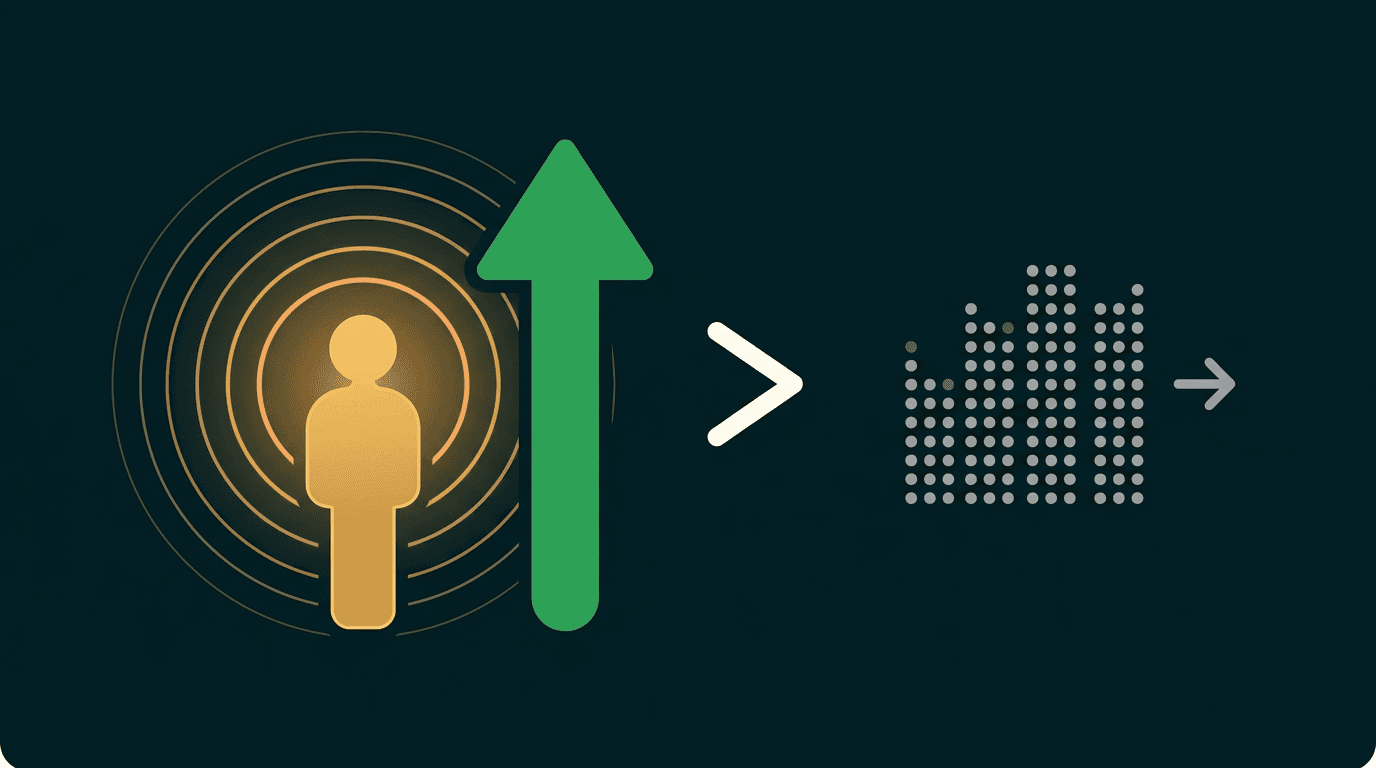
The concept originates with economist Thomas Schelling, who observed in 1968 that "the death of a particular person evokes anxiety and sentiment, guilt and awe... but the death of an unidentified person is a statistic." Schelling wasn't conducting experiments -- he was articulating something that military planners, journalists, and fundraisers had observed for decades: specificity drives action in ways that abstraction cannot.
The experimental confirmation came nearly four decades later.
Small, Loewenstein, and Slovic (2007)
In 2007, researchers Deborah Small, George Loewenstein, and Paul Slovic published a study that should be required reading for every nonprofit communicator. They presented participants with two different appeals for donations to address food insecurity in Africa.
Appeal A presented statistical information: food shortages affecting millions of Zambians, crop failures in Malawi, the scale of the crisis across the continent. It was factual, comprehensive, and devastating.
Appeal B told the story of Rokia, a seven-year-old girl from Mali. It described her life, her circumstances, and what a donation would mean for her specifically.
The results were stark:
- Participants who received Rokia's story donated an average of $2.38
- Participants who received the statistical appeal donated an average of $1.43
Rokia's story generated 66% more giving than the statistical appeal.
The Dangerous Third Condition
But the study's most important finding involved a third group. These participants received both Rokia's story and the statistical information, combined in a single appeal.
Donations in this combined condition dropped back to $1.43 -- the same as statistics alone.
Adding data to the story didn't strengthen it. It weakened it. The statistics appeared to trigger a shift from emotional to analytical processing, effectively "canceling out" the empathic response that Rokia's story had generated.
Proportion Dominance and Psychic Numbing
Slovic's subsequent research identified two related phenomena:
Proportion dominance: People are more willing to help when they can save a large proportion of a group than when they can save the same absolute number from a larger group. Saving 4,500 out of 11,000 lives in a refugee camp generates more support than saving 4,500 out of 250,000 -- even though the same number of people are helped.
Psychic numbing: As the number of victims increases, empathy per victim decreases. One child starving produces a powerful emotional response. A thousand children starving produces a weaker one per child. A million children starving produces almost no individual emotional response at all. The brain cannot hold empathy for a million people simultaneously, so it disengages.
The Determined Identity Experiment
In a follow-up study, Small and Loewenstein (2003) found that merely determining the identity of a victim -- even through a random process with no information gain -- increased giving. Participants gave more to "the family drawn in the lottery" than to "a family from the list," even though both descriptions pointed to the same set of potential recipients. The act of identification itself, even arbitrary identification, triggered greater generosity.
Implications for Nonprofit Communications
-
Always lead with one person's story, not aggregate data. "We served 10,000 meals" is less effective than "When Maria sat down to her first hot meal in three days, she cried."
-
Use data to support a story, never to replace one. After your audience has connected emotionally with Maria, then you can say: "Last year, we served 10,000 people like Maria." The story creates the emotional framework; the data provides scale.
-
Be cautious about combining emotional appeals with analytical information in the same communication. The Small/Loewenstein/Slovic finding is counterintuitive but robust: adding statistics to a personal story can trigger a shift from emotional to analytical processing, reducing the impulse to give.
-
Name, specify, and individualize whenever possible. "A family in need" is abstract. "The Rodriguez family -- Maria, Carlos, and their three children, ages 8, 5, and 2" is concrete. Specificity is the engine of emotional engagement.
-
Beware the "scale trap." Communicating the enormous scope of a problem may actually reduce the audience's willingness to act, because the brain interprets the problem as too large for any individual contribution to matter.
The Ethical Dimension
The identifiable victim effect raises important ethical questions that we will explore in depth in Lesson 3. Using individual stories to drive donations is effective, but it creates obligations: to the person whose story is told, to the communities they represent, and to the audience whose empathy is being engaged. The power of the identifiable victim effect is precisely why dignity, consent, and ethical framing matter so much. A tool this powerful demands responsible use.
Key Insight: The identifiable victim effect is not a marketing trick. It is a deep feature of human cognition. Working with it ethically -- centering real people's stories with their informed consent, representing them with dignity, and using specificity to build genuine connection -- is the foundation of effective nonprofit communication.
Stories vs. Information: The Quantitative Evidence
The research on neural coupling, neurochemistry, and the identifiable victim effect converges on a single conclusion: stories and information are processed by fundamentally different brain systems, and the story system is dramatically more effective at driving human behavior.
This does not mean data is useless. It means data serves a different function than most nonprofit communicators assume.
The Evidence Table
The following table summarizes key findings from the research literature comparing story-driven and data-driven communication:
| Metric | Story-Driven | Data-Driven | Source |
|---|---|---|---|
| Recall after 24 hours | 63% of listeners remember | 5% of listeners remember | Heath, Made to Stick (Stanford) |
| Donation rate | 47% higher | Baseline | Wharton School of Business |
| Average donation amount | $2.38 | $1.43 | Small, Loewenstein & Slovic (2007) |
| Brain regions activated | 7+ regions (whole brain) | 2 regions (language only) | Hasson, Princeton (2010) |
| Memorability multiplier | 22x more memorable than facts alone | Baseline | Bruner, cognitive psychology |
| Emotional engagement | Oxytocin + cortisol + dopamine cascade | Minimal neurochemical response | Zak, Claremont (2014) |
Every row tells the same story: narrative-format communication outperforms information-format communication by significant margins across every measurable dimension.
The "Story Shows" Framework
One way to think about the difference: information tells the audience what to think. Story shows the audience what to feel, and lets them draw their own conclusions.
| Instead of Telling... | Show... |
|---|---|
| "Our program is effective" | One person's journey from enrollment to outcome |
| "Hunger is a serious problem" | What 6:00 PM looks like in a household where there is no dinner |
| "We need your support" | What becomes possible when a donor's contribution meets a specific need |
| "Our community is resilient" | A moment when someone in the community made a choice that changed the trajectory |
The "Show, Don't Tell" principle is not just a creative writing guideline. It is a neurologically grounded communication strategy. Showing activates sensory cortex, motor cortex, and emotional centers. Telling activates only language-processing areas.
The Story-First Principle
Effective nonprofit communication follows what we call the story-first principle: open with a specific person's experience, build emotional engagement through narrative, deliver transformation, and then -- only after the audience is emotionally invested -- provide the data that demonstrates scale and credibility.
| Approach | Pattern | Brain Response | Effectiveness |
|---|---|---|---|
| Information-first | Data > Problem > Ask | Analytical processing only | Low recall, low action |
| Story-first | Person > Tension > Change > Data | Emotional + analytical processing | High recall, high action |
Most nonprofit communication follows an instinctive but ineffective pattern: lead with the problem, present the data, make the ask. This pattern feels logical, comprehensive, and professional. It is also neurologically backward.
The research-backed pattern reverses the order: lead with a person, build the tension, show the transformation, then provide data as context.
This is not manipulation. It is communication design that respects how the human brain actually processes information. Your audience's brain will do what brains do: ignore uncontextualized data and engage with specific human experience. Working with that reality is more honest than pretending it doesn't exist.
Boundary Conditions: Where Stories Are Not Enough
The research on storytelling's power is robust, but it is not a blank check. There are contexts in which data-driven communication is more appropriate, more effective, or more ethical than narrative-driven communication. A responsible communicator knows both when to tell a story and when not to.
Donor Fatigue and Compassion Saturation
Research on compassion fatigue suggests that approximately 70% of regular donors report feeling overwhelmed by the volume of emotional appeals they receive. Repeated exposure to suffering-focused messaging produces diminishing returns and, eventually, active avoidance. This is particularly acute in disaster-relief contexts, where multiple organizations compete with similar narratives of urgent need.
The implication is not that stories should be abandoned, but that they must be varied. An organization that tells only crisis stories will eventually exhaust its audience's emotional bandwidth. Mixing crisis narratives with transformation stories, resilience stories, and celebration stories maintains engagement without burning out the audience's capacity for empathy.
Institutional Funders and the Calculative Mindset
Foundation program officers, government grant reviewers, and institutional funders operate in what researchers call a "calculative mindset." They are professionally obligated to evaluate proposals based on evidence, cost-effectiveness, logic models, and measurable outcomes. For these audiences, leading with a highly emotional personal narrative can backfire -- it may be perceived as anecdotal, manipulative, or insufficient.
The effective approach for institutional audiences is not story or data, but story anchored to data. Open with a brief narrative that illustrates your theory of change in human terms, then provide the analytical framework: cost-per-impact, outcome metrics, comparison data, and evaluation methodology. The story humanizes the data. The data validates the story.
Asset-Based vs. Deficit-Based Framing
A growing body of research in community development and social work challenges the dominance of deficit-based storytelling -- narratives that center suffering, lack, and vulnerability. These stories can be effective fundraising tools, but they carry significant risks:
- They can reinforce stereotypes about the communities being described
- They position the organization as "savior" and the community as passive recipient
- They can cause psychological harm to the individuals whose stories are told
- They can create a distorted picture of community capacity and resilience
Asset-based storytelling -- narratives that center a community's strengths, choices, agency, and existing resources -- produces more sustainable engagement and avoids the ethical pitfalls of deficit framing. We will explore this distinction in depth in Lesson 3.
The Sophistication Spectrum
Not every audience responds to stories the same way. Research suggests that narrative effectiveness varies based on:
- Audience expertise: Subject-matter experts may respond better to data-driven communication about topics they know well
- Prior exposure: Audiences saturated with emotional appeals (e.g., in disaster-relief contexts) may develop compassion fatigue and require different approaches
- Cultural context: Different cultural traditions have different narrative forms, and a structure that resonates in one context may not translate to another
- Communication channel: A 280-character social media post, a 30-minute documentary, and a 10-page grant narrative all require different story-to-data ratios
Key Insight: The key principle is not "always use stories" but "understand what each communication context requires and design accordingly." This lesson gives you the science behind story's power. The rest of the course gives you the judgment to wield it well.
Where Nonprofits Need Stories: The Six Contexts
Understanding the science of story is essential, but it is not sufficient. You also need to understand where and how nonprofit organizations deploy stories across their communication ecosystem.
Research and practice identify six primary contexts where storytelling is critical for mission-driven organizations:
| Context | Primary Audience | Story Function | Key Challenge |
|---|---|---|---|
| Fundraising | Individual donors, major donors | Create emotional connection to trigger giving | Balancing urgency with dignity; avoiding exploitation |
| Awareness Campaigns | General public, media | Build understanding and visibility for an issue | Breaking through noise; avoiding oversimplification |
| Board & Governance | Board members, advisory councils | Ground strategic decisions in human impact | Keeping governance connected to mission, not just metrics |
| Donor Stewardship | Existing donors and funders | Demonstrate impact and deepen commitment | Showing transformation without "before/after" exploitation |
| Staff & Volunteer Engagement | Internal teams, volunteers | Sustain motivation and organizational culture | Preventing burnout; maintaining connection to purpose |
| Impact Reporting | Funders, public, regulators | Communicate measurable outcomes with human context | Integrating data and narrative without undermining either |
What Each Context Demands
Fundraising stories must lead with character and tension, build empathy, and connect the audience's potential action (donating) to a specific, credible outcome. The identifiable victim effect is most directly relevant here.
Awareness campaign stories must be shareable, concise, and emotionally resonant enough to break through the noise of competing information. They often require simplification, which creates tension with accuracy and nuance.
Board and governance stories serve a different function: they anchor strategic conversations in the human impact that data alone can obscure. A board reviewing quarterly metrics sees numbers. A board that also hears one client's story understands what the numbers represent.
Donor stewardship stories close the loop. They show existing donors what their contributions accomplished -- not in aggregate terms ("your dollars helped 500 families") but through the specific transformation of a specific person. This is what turns one-time donors into recurring supporters.
Staff and volunteer stories sustain the internal culture of a mission-driven organization. Burnout is endemic in the nonprofit sector. Stories of impact -- hearing directly from the people served -- are among the most effective tools for maintaining motivation and connection to purpose.
Impact reporting stories bridge the gap between quantitative accountability and qualitative meaning. The most effective impact reports pair metrics with narrative: "Our retention rate increased from 62% to 84% this year. Here is what that number looks like in one student's life."
Key Insight: Most organizations are reasonably good at one or two of these contexts and neglect the others. The organizations that communicate most effectively deploy story consistently across all six.
Stories in Action: Four Case Studies
The following case studies illustrate how the principles from this lesson translate into measurable fundraising and engagement outcomes.
Charity:Water — The Power of One Person's Story
Charity:Water's founding story centers on Scott Harrison's personal journey from nightclub promoter to clean-water advocate. But the organization's ongoing success is built on a more specific application of the identifiable victim effect: every campaign connects one donor to one community's water project.
Rather than communicating in aggregate ("we've served 17 million people"), Charity:Water's signature approach gives donors GPS coordinates for the specific well their contribution funded, and then follows up with photos and stories from the specific community that well serves. The identifiable victim effect operates at scale -- not by telling one story to millions, but by creating millions of one-to-one connections.
Result: Charity:Water has raised over $800 million by making every donor feel like they funded a specific, visible outcome rather than contributing to a general fund.
Operation Smile — Video Storytelling and Surgical Transformation
Operation Smile provides reconstructive surgery for children born with cleft lip and cleft palate. Their storytelling strategy follows the neurochemical sequence almost perfectly: tension (a child unable to eat, speak, or attend school), character (a specific child with a name, a family, and a dream), and transformation (the surgical procedure and its aftermath).
Their short-form video content consistently follows a three-act structure: the child's life before surgery, the moment of transformation, and the new possibilities that follow. Each video centers one child and one family -- never aggregating into statistics until after the emotional connection is established.
Result: Operation Smile's story-driven campaigns have produced 161% increases in online donations compared to data-driven appeals, and their donor retention rates significantly exceed the sector average.
Hope Haven — Donor Stewardship Through Personal Narrative
Hope Haven, a disability services organization, restructured their donor stewardship program around personal narrative. Rather than sending quarterly reports with aggregate metrics, they began pairing each major donor with a specific individual served by the program and providing regular story-based updates on that individual's progress (with full informed consent from the individual and their family).
Result: Donor retention increased by 30%, and the average gift size for retained donors increased by 22%. Donors reported feeling "personally connected" to the organization's mission in ways that aggregate reporting had never achieved.
The Humane Society — From Statistics to Stories
The Humane Society of the United States shifted its direct-mail fundraising from statistics-heavy appeals to individual animal rescue stories. Each piece featured one animal: a name, a photo, a rescue narrative, and a transformation. The statistical context (millions of animals in shelters) was moved to the final paragraph, after the emotional connection was established.
Result: Year-over-year fundraising revenue increased by 30%, with particular gains in first-time donor acquisition. The story-first approach proved especially effective at converting awareness into initial giving.
Pattern: In every case, the organization's breakthrough came from applying the same core principles: lead with one specific individual, build tension and emotional connection, show credible transformation, and use data only as supporting context after the audience is emotionally engaged.
People Give to People
The science converges on a single, actionable truth:
People give to people. Not to organizations, not to programs, not to data.
This lesson has armed you with the evidence:
-
Neural coupling means your audience's brain will literally mirror the experience you create -- if you give them a narrative to synchronize with. Facts activate two brain regions. Stories activate the entire brain.
-
Neurochemical research (with appropriate caveats about replication) demonstrates that character-driven narratives trigger the emotional and physiological responses that lead to prosocial behavior. The behavioral finding is robust even where the precise mechanism is still being refined.
-
The identifiable victim effect shows that one person's story generates more giving than statistics about millions -- and that combining statistics with a personal story can actually reduce the impulse to give.
-
Quantitative evidence across multiple studies shows story-driven appeals outperforming data-driven appeals by margins of 47-161% in donation rates, with 12-22x advantages in memorability and recall.
But the science also demands responsibility. Donor fatigue is real. Institutional audiences need data. Deficit-based framing harms communities. The identifiable victim effect creates ethical obligations to the people whose stories are told. Effective communication requires knowing both when to use story and when to lead with evidence, analysis, or systemic framing.
Your organization is the bridge, not the protagonist. The most effective nonprofit communicators position their organization as the vehicle through which a donor's generosity meets a specific person's need. The donor is the hero. The beneficiary is the character we root for. The organization is the mechanism that makes the connection possible.
When you internalize this framework, everything changes: your fundraising appeals, your annual reports, your social media, your board presentations, your grant narratives, your volunteer recruitment. All of it becomes more effective, because all of it begins to work with the brain's architecture instead of against it.
What Comes Next
In Lesson 2, we move from the science of why stories work to the craft of how to build them. You will learn the essential elements that every impact story needs, structural frameworks for organizing your narrative, and how to match story structure to audience and channel.
But first, take what you've learned here and apply it. Look at your organization's most recent appeal, your last annual report, your website homepage. Ask yourself: does this communication lead with a person or with data? Does it create tension and resolution? Does it center transformation or just report activities?
The answer will tell you exactly where to start.
Exercise 1
Story vs. Information Transformer
Rewrite this information-style statement as a 1-2 sentence story. Add a specific person and a concrete moment.
- Rewrite: "Our mental health services have a 73% positive outcome rate."
Your response will be saved and reviewed by AI Coach
Knowledge Check
Question 1 of 4
When a listener hears a well-told story, research shows their brain activity: